Learn to Play
Whether you are a youth player yourself or a parent of a youth player, use this step-by-step guide to learn where and how to start playing tennis, and how to progress from one level to the next!

Whether you are a youth player yourself or a parent of a youth player, use this step-by-step guide to learn where and how to start playing tennis, and how to progress from one level to the next!
Kids’ Tennis is used as a developmental tool to allow young children to improve their overall tennis skills faster so they can transition to the regular court with more ease. Kids’ Tennis allows youngsters to train and compete with courts and equipment that are better suited for their size.
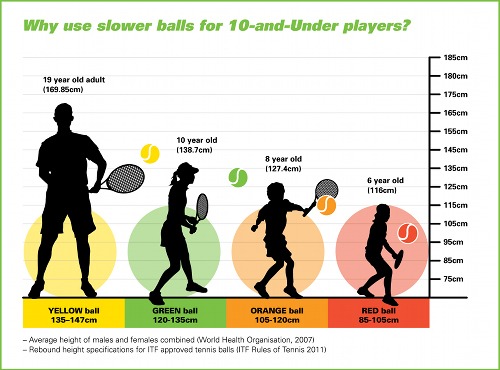
A mini-revolution is brewing in North America. The approach is called “Kids’ Tennis.” It is imported from European countries such as France and Belgium where it was used to successfully develop players like Justine Henin-Hardenne and Olivier Rochus. Kids’ Tennis uses a systematic progression of court sizes, balls, and racquets, to scale the game down to an appropriate level for 5 to 10 years old.
Modified racquets and balls are not new. The equipment has been around for a while, as has the ‘graduated length’ concept. Coaches have used bits and pieces for years seeing the advantage from the perspective of success, fun, and safety. The difference this time is that all these elements have been brought together in a much more systematic way than ever before. Tennis companies now carry the full line of half-court and three-quarter-court progressive equipment including graduated balls, racquets, lay-down lines, and nets.
The power of the Kids’ Tennis system is that it allows players to play quickly and successfully. In Kids’ Tennis, the philosophy is that tennis is a great and fun game to play, and the quicker and more skillfully a player can play, the more fun it is. Each stage not only has specific equipment to aid success, but particular skills to develop as well. It is recommended a Game-Based Approach be used. The coach’s job is to get them to play and help them learn to play better.
Simply put, “Kids’ Tennis” is used as a developmental tool to allow young children to improve their overall tennis skills faster so they can transition to the regular court with more ease.
See below for the Progressive Stages of Kids’ Tennis.

Half-Court tennis is the first step in Kids’ Tennis. The transition to successful half-court tennis will require a period of skill development where basic coordination and cooperative activities will lead to the development of the basic strokes and fundamentals. Hence, Half-Court programs will often need to be broken into two programs: one for experienced kids who have some basic exchanging ability who will be able to begin competing and training at half court, and the other for kids who are just starting the game.
Court Dimensions (there are two options):
Note: Either length is fine for competition or training, although using the width of the court is more conducive for larger numbers as you can have six practice courts and four competition courts. The service-court option provides only two competition courts and practice courts.

The Three-quarter Court stage is the most important stage of this progressive development. As the court dimensions are adjusted to be smaller but with a similar ratio to the full court. This step helps ensure the development of an all-court game style with net play. The key is to develop the same tactics as full-court tennis along with the associated techniques.
Players will move to Three-quarter Court once they have a full repertoire of skills at the half court. For most players who have gone through the half court program, this transition will take place at seven years of age. There will also be some late starters or less coordinated players who will make this transition at eight to nine years of age.

Players will move to full court once they have a full repertoire of skills at the three-quarter court. For some very highly skilled players, this will be at eight years of age, however, for most players who have gone through the half- and three-quarter-court programs, this transition will take place at nine years of age. There will also be some late starters or less athletic players who will make this transition at 10 years of age.
This transition to full-court tennis will take place in a two-step process. The first step will be with a transition ball which provides a more lively bounce than the low-compression ball but not as much of a bounce as the regular ball (this will help promote the continued development of proper technique). This will help ensure longer points. The final step will be using the regular ball.

The Yellow Ball stage is for players 11 plus. It is played on a full-size court with full sized-rackets and full-compression yellow tennis balls. It is the final stage in the progressive kids’ tennis model.
Click here to view an updated list of Coaches in BC
If your pro’s name is not listed there, then the person either does not have current certification and/or is not a current member of the TPA.